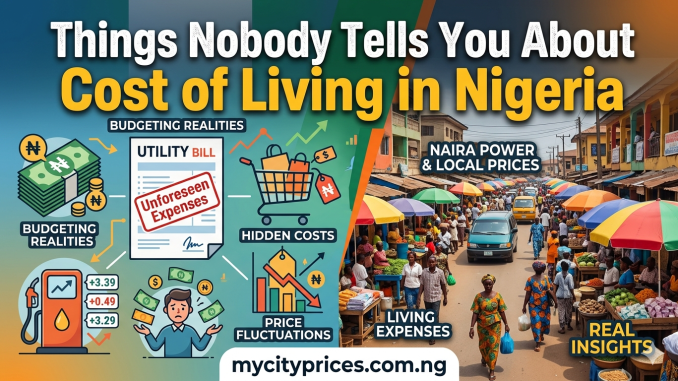
Things Nobody Tells You About Cost of Living in Nigeria (Real Life Experience)
If you’ve ever Googled “cost of living in Nigeria”, you’ve probably seen clean breakdowns like rent, food, transport, and maybe internet. Everything looks simple on paper.
But in real life? It’s a completely different story.
I’ve lived it. And the truth is, there are hidden costs, silent drains, and everyday surprises that no blog really prepares you for. This is not one of those sugar-coated articles — this is what actually happens when you’re trying to survive (or even just live comfortably) in Nigeria.
Let me break it down the way it really is.
1. Your Budget Will Never Stay the Same
One thing nobody tells you is that your monthly budget in Nigeria is almost useless after 2–3 weeks.
Prices change constantly.
- Today, a crate of eggs is ₦4,500
- Next week, it’s ₦5,800
- Fuel goes up → transport goes up → food goes up
It’s like everything is connected, and when one thing moves, everything else follows.
I remember planning a “tight” monthly budget one time. By the third week, I was already dipping into savings because:
- Tomatoes suddenly doubled
- Transport fares increased overnight
- My generator started consuming more fuel
There’s no stability. You don’t just plan your finances in Nigeria — you adjust daily.
2. Rent Is Just the Beginning (Not the Real Cost)
Most people think rent is the biggest expense. That’s only half the truth.
Let’s say you get a house for ₦500,000 per year. Sounds okay, right?
Now add:
- Agent fee (10–20%)
- Agreement fee (10%)
- Caution fee
- Legal fee
- Commission
- Sometimes even “inspection fee”
Before you know it, that ₦500k house has turned into ₦750k – ₦900k upfront.
And that’s not all.
After moving in, you still deal with:
- Constant repairs (plumbing, wiring, leaks)
- Buying your own water tank or pumping machine
- Security contributions
- Waste disposal fees
Nobody tells you that rent is just the “entry fee” into a long list of expenses.
3. Electricity Is Not Reliable (So You Pay Twice)
In Nigeria, you don’t just pay for electricity — you pay for alternatives.
Even if you’re using prepaid meter:
- You buy units
- Light still isn’t stable
So what do you do?
You buy:
- Fuel for generator
- Or inverter + batteries
- Or solar (if you can afford it)
Let me be honest — running a generator can quietly drain your money faster than rent.
There were months I spent:
- ₦25,000 – ₦50,000 on fuel alone
And that’s just for basic usage (fan, TV, charging phones).
Nobody prepares you for the fact that electricity in Nigeria is a double expense system.
VIEW ALSO : Real Cost of Living in Abuja for a Single Person
4. Food Is Where Money Disappears Quietly
Food is one of the biggest “silent killers” of your income.
At first, you think:
“I’ll just cook at home to save money.”
But then reality hits.
- Foodstuff prices change every week
- Cooking gas finishes faster than expected
- You still end up buying food outside when tired
Let me give you a real scenario:
You go to the market with ₦10,000 thinking you’ll buy enough for a week.
You come back with:
- Half basket of tomatoes
- Small rice
- A few proteins
And the money is gone.
Now add:
- Snacks
- Drinks
- Random cravings
You’ll realize food alone can take 30–50% of your monthly income without you noticing.
5. Transport Is Unpredictable (And Mentally Draining)
Transport in Nigeria is not just about money — it’s about stress.
You can budget ₦500 per trip today, and tomorrow it becomes ₦800.
Reasons?
- Fuel price increase
- Traffic
- Weather
- “No change” wahala
- Drivers increasing fares randomly
If you use public transport daily, you’ll understand this pain.
And if you use ride-hailing apps?
Surge pricing will humble you.
One day, a trip costs ₦2,500
Next day, same distance = ₦4,800
No explanation.
Transport is one of those expenses you cannot fully control.
6. You’ll Always Spend on “Unexpected Things”
This is the biggest one nobody tells you.
Every month, something will come up that you didn’t plan for.
Examples:
- Friend’s birthday contribution
- Family emergency
- Church or association levy
- Phone suddenly spoils
- Medical bills (even small ones)
Nigeria has a way of introducing “urgent 2k” situations every week.
And these small, unplanned expenses add up.
You may think you’re managing your money well, but these unexpected costs will keep pulling you back.
7. Data Subscription Is Now a Basic Need
Internet is no longer a luxury — it’s survival.
Whether you’re:
- Working online
- Running a business
- Scrolling social media
You’ll spend on data. A lot.
Typical monthly data cost:
- ₦10,000 – ₦30,000 (depending on usage)
And the painful part?
Data finishes fast.
Very fast.
You’ll subscribe today and before you know it, it’s gone — especially with apps like TikTok, Instagram, and YouTube.
8. “Soft Life” in Nigeria Is Expensive
Let’s be real.
If you want to enjoy life even a little — eat out, go out, dress well — your expenses will multiply.
A simple outing can cost:
- Food: ₦5,000 – ₦15,000
- Drinks: ₦3,000+
- Transport: ₦2,000 – ₦10,000
One outing = someone’s weekly budget gone.
That’s why many people look like they’re living soft life online, but behind the scenes, their finances are struggling.
9. Medical Costs Can Shock You
Healthcare is another hidden cost people underestimate.
Even small things like:
- Malaria treatment
- Typhoid test
- Basic consultation
Can cost more than expected.
If it becomes something serious?
You’ll need serious money.
And since many people don’t have proper health insurance, everything is out-of-pocket.
10. Saving Money Is Harder Than It Looks
You’ll hear advice like:
“Save 20% of your income every month.”
Sounds good in theory.
But in Nigeria?
After paying for:
- Rent
- Food
- Transport
- Bills
- Unexpected expenses
What’s left?
Saving requires serious discipline and sometimes sacrifice.
Many people are not broke because they’re careless — they’re broke because the system is expensive.
11. Your Income Determines Your Experience Completely
This is the real truth.
Two people can live in the same city and have completely different experiences.
- One person earning ₦100k → struggling
- Another earning ₦500k → comfortable
- Another earning ₦1M+ → enjoying
Nigeria is not just expensive — it’s relative.
Your income decides:
- Your comfort
- Your stress level
- Your lifestyle
12. Location Changes Everything
Living in places like:
- Abuja
- Lagos
Is very different from smaller cities.
For example:
- Rent in Abuja = high
- Transport = higher
- Food = slightly higher
But opportunities are also more.
So while cost of living is higher in big cities, many people still move there because that’s where the money is.
Real Cost of Living Tables (Abuja vs Lagos vs Benin City)
Let me break this down with actual numbers so you don’t think I’m exaggerating.
These are not “perfect textbook prices” — this is what you’ll realistically spend depending on your lifestyle and area.
🏠 Rent (Yearly – Self Contained / 1 Bedroom)
| City | Budget Area | Decent Area | High-End Area |
|---|---|---|---|
| Abuja | ₦800k – ₦1.2M | ₦1.5M – ₦3M | ₦4M+ |
| Lagos | ₦700k – ₦1.5M | ₦2M – ₦4M | ₦5M+ |
| Benin City | ₦200k – ₦400k | ₦400k – ₦800k | ₦1M+ |
👉 Real talk: Benin is still one of the few places where rent hasn’t completely gone crazy yet.
🍚 Food & Groceries (Monthly – Single Person)
| Category | Abuja | Lagos | Benin |
|---|---|---|---|
| Basic foodstuff | ₦80k – ₦150k | ₦100k – ₦180k | ₦50k – ₦100k |
| Eating out (occasional) | ₦20k – ₦50k | ₦30k – ₦80k | ₦15k – ₦40k |
| Total Food Budget | ₦100k – ₦200k | ₦130k – ₦250k | ₦70k – ₦140k |
👉 In Lagos, food drains money faster because of lifestyle + convenience spending.
🚗 Transport (Monthly)
| Type | Abuja | Lagos | Benin |
|---|---|---|---|
| Public transport | ₦30k – ₦60k | ₦40k – ₦80k | ₦15k – ₦40k |
| Ride-hailing (Bolt/Uber) | ₦50k – ₦120k | ₦80k – ₦150k | ₦30k – ₦80k |
👉 Lagos is the most expensive because of traffic + fuel cost + distance.
⚡ Utilities (Monthly)
| Expense | Abuja | Lagos | Benin |
|---|---|---|---|
| Electricity (NEPA) | ₦10k – ₦25k | ₦15k – ₦30k | ₦5k – ₦15k |
| Generator fuel | ₦20k – ₦60k | ₦30k – ₦80k | ₦15k – ₦40k |
| Internet/Data | ₦10k – ₦25k | ₦15k – ₦30k | ₦8k – ₦20k |
👉 Fuel alone is one of the biggest hidden expenses in Nigeria right now.
📊 Full Monthly Living Estimate (Realistic Lifestyle)
| City | Low Budget | متوسط (Comfortable) | Soft Life |
|---|---|---|---|
| Abuja | ₦250k – ₦400k | ₦400k – ₦700k | ₦800k+ |
| Lagos | ₦300k – ₦500k | ₦500k – ₦900k | ₦1M+ |
| Benin City | ₦150k – ₦300k | ₦300k – ₦500k | ₦600k+ |
👉 A “comfortable life” in Lagos or Abuja now easily crosses ₦500k/month.
🧾 Screenshot-Style Breakdown (What My Month Looked Like)
This is a realistic example from my own experience (no sugarcoating):
One random month living in Abuja:
- Rent (when broken monthly): ₦180,000
- Food: ₦120,000
- Transport: ₦50,000
- Fuel (generator): ₦35,000
- Data: ₦18,000
- Misc (unexpected expenses): ₦40,000
👉 Total: ~₦443,000
And this wasn’t even “soft life”.
⚠️ What These Tables Don’t Show (But You’ll Feel)
Even with all these numbers, there are still things tables won’t capture:
- Prices changing every week
- Random “urgent 5k” situations
- Helping family (this one is real)
- Buying things twice (because quality no last)
- Lifestyle pressure
That’s why two people earning the same salary can live completely different lives in Nigeria.
Final Reality Check
If you’re planning your life based on just numbers like this, you’ll be shocked.
Because in Nigeria:
Your real cost of living is always higher than your calculated cost.
But if you understand these hidden costs early, you’ll survive better than most people.
Final Thoughts (The Real Truth)
Living in Nigeria is not just about surviving — it’s about constantly adapting.
Nobody tells you that:
- Prices will keep changing
- Expenses will keep appearing
- And your budget will rarely go as planned
But here’s the honest part:
You can still live well.
You just need to:
- Be financially aware
- Avoid unnecessary spending
- Increase your income if possible
- And always expect the unexpected
Because in Nigeria, the real cost of living is not just money — it’s how well you can adjust to constant change.
Leave a Reply