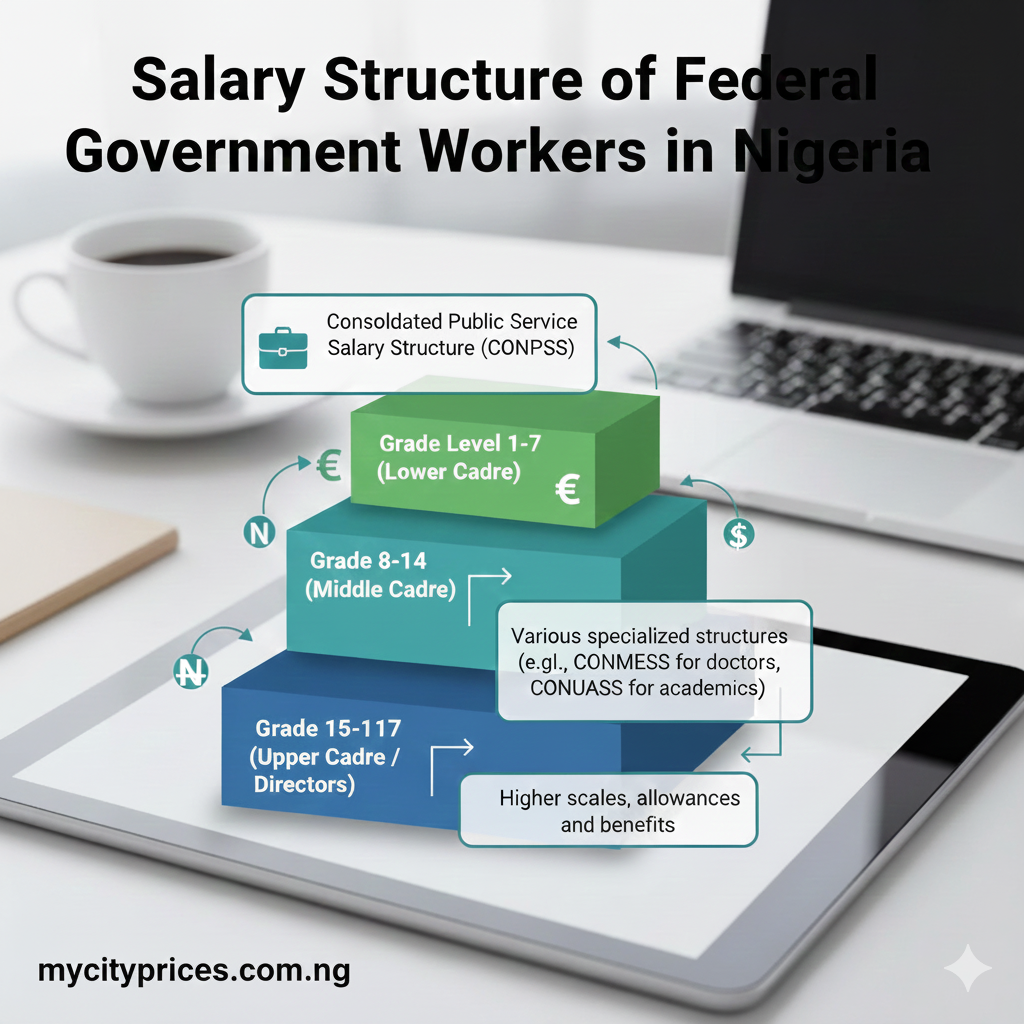
Salary Structure of Federal Government Workers in Nigeria (Complete Guide)
Understanding the salary structure of federal government workers in Nigeria is important for job seekers, civil servants, and anyone interested in public sector careers. The Nigerian federal government employs thousands of workers across ministries, departments, agencies, paramilitary organizations, and regulatory bodies.
This guide explains how federal salaries are structured, including all levels of government workers — from entry-level staff to top directors — as well as allowances, grade levels, steps, and other benefits.
If you are considering a career in the Nigerian public sector, this article will give you a clear and realistic picture of what to expect.
Overview of Nigeria’s Federal Salary Structure
Federal government workers in Nigeria are generally paid under standardized salary frameworks. The most common system for core civil servants is the:
CONPSS (Consolidated Public Service Salary Structure)
Other specialized structures exist for:
- Medical professionals
- Academic staff
- Armed forces
- Police and paramilitary agencies
- Judicial officers
However, this article focuses primarily on the general federal civil service salary structure while also covering related systems.
What Is Grade Level (GL) in Federal Government Jobs?
The Nigerian federal government salary system is based on:
- Grade Levels (GL)
- Steps (1–15)
✔ Grade Level (GL)
This indicates your rank or position in the civil service hierarchy. It usually ranges from:
- GL 01 (lowest level)
- GL 17 (highest administrative level before permanent secretary level)
✔ Steps
Each grade level contains Step 1 to Step 15, representing annual salary increments based on years of service.
The higher your grade level and step, the higher your salary.
Full Breakdown of Federal Government Salary Structure in Nigeria
Below is a detailed breakdown of salary ranges by grade levels (monthly estimates).
⚠ Note: Figures are approximate and may vary slightly depending on adjustments, promotions, and allowances.
Grade Level 01 – 06 (Junior Staff Level)
These levels typically include:
- Office assistants
- Clerical officers
- Drivers
- Messengers
- Support staff
💰 Estimated Monthly Salary:
- GL 01: ₦30,000 – ₦45,000
- GL 02: ₦35,000 – ₦50,000
- GL 03: ₦40,000 – ₦55,000
- GL 04: ₦45,000 – ₦60,000
- GL 05: ₦50,000 – ₦70,000
- GL 06: ₦60,000 – ₦85,000
These positions usually require:
- Primary or secondary school certificates
- Basic technical training
Grade Level 07 – 10 (Mid-Level Officers)
This level includes:
- Executive officers
- Administrative officers
- Inspectors
- Technical officers
💰 Estimated Monthly Salary:
- GL 07: ₦70,000 – ₦100,000
- GL 08: ₦90,000 – ₦130,000
- GL 09: ₦100,000 – ₦150,000
- GL 10: ₦120,000 – ₦170,000
Most university graduates enter the federal civil service at:
👉 GL 08 Step 1
Promotion to GL 09 and GL 10 follows based on years of service and performance.
Grade Level 12 – 14 (Senior Officers)
These levels include:
- Senior administrative officers
- Principal officers
- Senior accountants
- Senior engineers
💰 Estimated Monthly Salary:
- GL 12: ₦160,000 – ₦220,000
- GL 13: ₦180,000 – ₦250,000
- GL 14: ₦200,000 – ₦300,000
At this level, responsibilities increase significantly, and officers may supervise departments or units.
Grade Level 15 – 17 (Top Management Level)
These levels include:
- Directors
- Assistant directors
- Permanent secretary (administrative apex)
💰 Estimated Monthly Salary:
- GL 15: ₦250,000 – ₦350,000
- GL 16: ₦300,000 – ₦450,000
- GL 17: ₦400,000 – ₦600,000+
At the highest levels, allowances significantly increase total earnings.
Salary Structures for Specialized Federal Workers
Apart from the general civil service, other federal employees are paid under specialized salary systems.
VIEW ALSO :
- Which agency has the highest salary in Nigeria?
- Central Bank Of Nigeria CBN vs Federal Inland Revenue Service FIRS Salary
1. Armed Forces Salary Structure
The military operates under a separate structure.
Estimated Monthly Salary:
- Recruit: ₦50,000 – ₦70,000
- Lieutenant: ₦180,000 – ₦250,000
- Colonel: ₦550,000 – ₦1,000,000+
- General: ₦1,500,000+
Military officers also receive housing, risk, and operational allowances.
2. Police Salary Structure
Police officers are paid under a consolidated police salary system.
Estimated Monthly Salary:
- Recruit: ₦45,000 – ₦65,000
- Inspector: ₦120,000 – ₦180,000
- Superintendent: ₦200,000 – ₦350,000
- Commissioner: ₦500,000+
3. Federal Medical Workers (CONMESS)
Doctors and medical officers are paid under a special structure.
Estimated Monthly Salary:
- Medical officer (entry): ₦250,000 – ₦350,000
- Consultant: ₦600,000 – ₦1,200,000+
They also receive hazard allowances.
4. Federal University Lecturers (CONUASS)
Academic staff salaries vary by rank:
Estimated Monthly Salary:
- Lecturer II: ₦140,000 – ₦200,000
- Senior Lecturer: ₦300,000 – ₦450,000
- Professor: ₦450,000 – ₦800,000+
Allowances for Federal Government Workers
Federal workers do not rely on basic salary alone. They receive several allowances.
Common Allowances Include:
✔ Housing Allowance
✔ Transport Allowance
✔ Utility Allowance
✔ Leave Allowance
✔ Medical Allowance
✔ Hazard Allowance (for risky jobs)
✔ Rural Posting Allowance
These allowances can increase total earnings by 20%–50% depending on role and location.
Annual Salary Growth and Promotion
Promotion usually occurs every 3–4 years, depending on:
- Performance evaluation
- Vacancy availability
- Exams and interviews
Each promotion increases both:
- Grade Level
- Step within the grade
Over time, this significantly increases income.
Comparison: Federal vs State Government Salary
Federal government workers generally earn more than state workers because:
- Federal salary scales are standardized nationwide
- Federal revenue is higher
- Allowances are often better funded
However, some wealthy states pay competitively.
Is Federal Government Salary Enough in 2026?
With inflation and economic fluctuations, many workers supplement income through:
- Small businesses
- Investments
- Skill development
However, federal government jobs remain attractive due to:
- Job security
- Pension benefits
- Stable payment
- Structured career progression
Benefits of Working for the Federal Government
Beyond salary, benefits include:
✔ Pension under contributory scheme
✔ Job stability
✔ Paid leave
✔ Training opportunities
✔ Loan access
✔ Retirement gratuity
These long-term benefits make federal jobs highly desirable.
Conclusion
The salary structure of federal government workers in Nigeria is organized, structured, and based on grade levels and steps. While entry-level salaries may seem modest, promotions, allowances, and long-term benefits significantly increase total compensation.
From junior clerical staff earning around ₦30,000 per month to directors earning over ₦600,000 monthly — the federal salary structure accommodates all levels of service.
For many Nigerians, the appeal of federal government work lies not just in salary, but in security, pension benefits, and career stability.
Frequently Asked Questions (FAQs)
1. What grade level do university graduates enter in federal government jobs?
Most graduates start at Grade Level 08 Step 1.
2. What is the highest salary in the federal civil service?
Top-level officers on GL 17 can earn between ₦400,000 and ₦600,000+ monthly, excluding allowances.
3. Do federal government workers receive allowances?
Yes. They receive housing, transport, medical, leave, and sometimes hazard allowances.
4. Is federal government salary paid monthly?
Yes. Salaries are paid monthly through the federal payroll system.
5. Can federal workers be promoted automatically?
Promotions are not automatic but are usually based on years of service, performance reviews, and available vacancies.
Leave a Reply