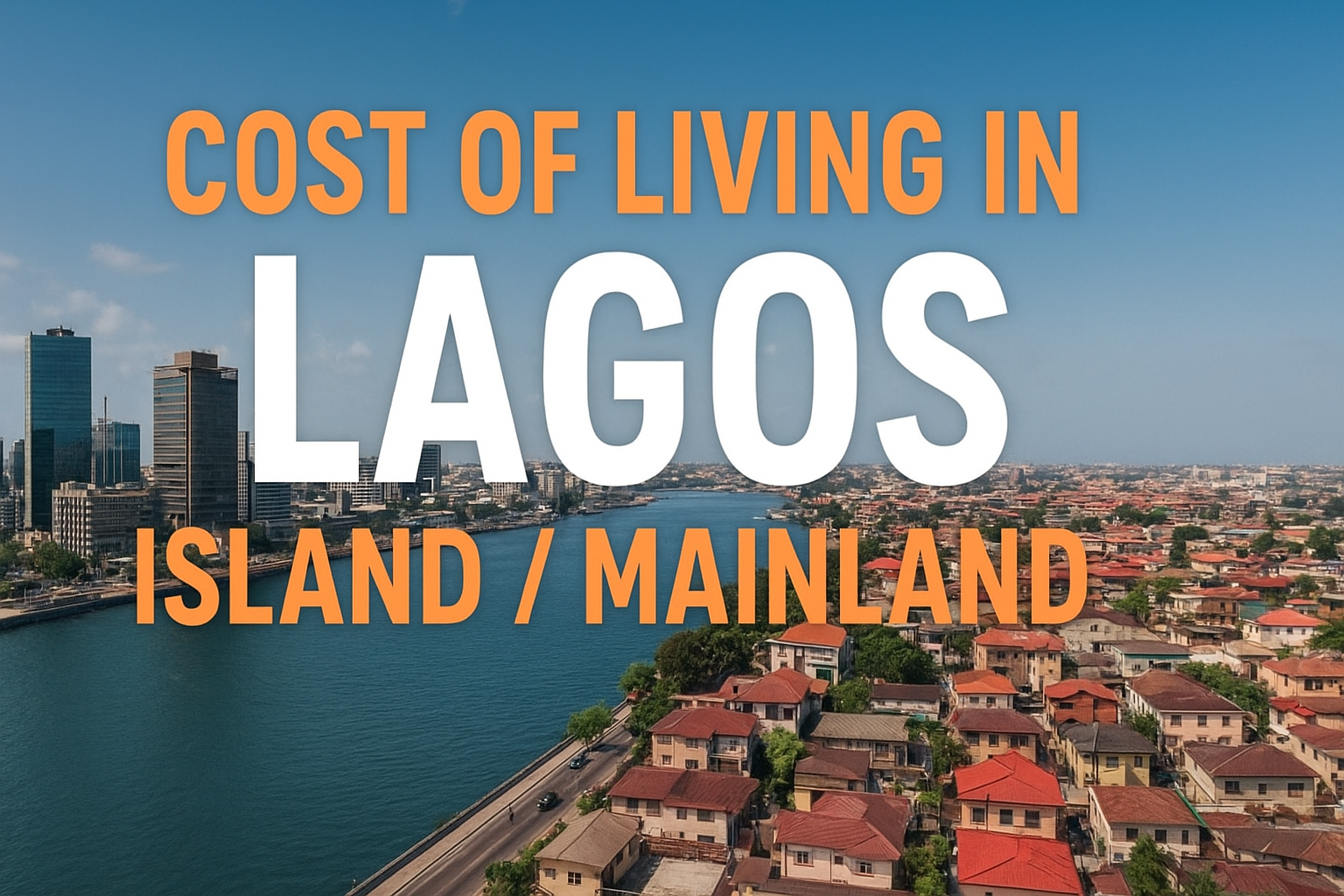
Lagos is Nigeria’s largest city and economic powerhouse. But not all parts of Lagos are the same — costs, conveniences, and lifestyles differ significantly between the Island (areas like Victoria Island, Ikoyi, Lekki) and the Mainland (areas like Ikeja, Surulere, Yaba). Understanding these differences can help both residents and newcomers make more informed decisions.
What We Mean by “Island” and “Mainland” in Lagos
- Lagos Island typically refers to areas on the lagoon side: Victoria Island, Ikoyi, Lagos Island proper, and parts of Lekki Phase 1. These are generally higher-income, high-density business or residential districts.
- Lagos Mainland refers to everything on the “continental” side of the lagoon — including neighborhoods like Ikeja, Yaba, Surulere, Mushin,Oshodi-Isolo, Iyana Ipaja, Gbagada, Agege, Ikorodu, and others.
2025-2026 Cost of Living: Top 10 Lagos Neighborhoods (Island & Mainland)
Below are 10 key Lagos neighborhoods, with average rent costs (based on recent data) and some details. Figures are mostly from 2026 estimates or recent reports.
| Neighborhood | Type | Typical Rent (2025) |
|---|---|---|
| Ikoyi | Island | Very high: According to Nigeria Property Centre, the average annual rent for houses in Ikoyi is ~₦47.21 million. Bamboo Routes gives 1-bed ~₦1.5 M–₦3.5 M/month, 3-bed up to ₦9 M+. |
| Victoria Island (VI) | Island | Average annual flat rent (from Nigeria Property Centre): ~₦16.62 million. Also, 1-bed asking rent per Bamboo Routes: ₦1 M–₦2.5 M/month. |
| Banana Island | Island | Very premium / luxury area. According to Flavor365, 3-bed can go from $80,000 – $150,000+ per year, which is extremely high in Naira. |
| Lekki Phase 1 | Island-ish / Transitional | According to Bamboo Routes, 1-bed: ~₦1.3 M–₂.5 M/month; 3-bed: ~₦2.5 M–₦4 M+. NigeriaPropertyCentre also lists flats in Lekki with average annual rent ~₦7.74 million. |
| Ikeja GRA / Ikeja area | Mainland | Nigeriapropertycentre: average house rent ~₦15.2 million/year. According to CleeC Designs, a 2-bed in Ikeja could be ₦1.5 M–₦3 M/year or more depending on the area. |
| Yaba | Mainland | 1-bed: ₦850k–₦1.3 M/month; 2-bed: ₦1.3 M–₦1.8 M; 3-bed: ₦1.7 M–₦2.8 M. LagosGlobal also mentions Yaba rent (for some units) around ₦150,000 for 2-bed (older units) but this likely refers to lower-spec flats. |
| Surulere | Mainland | From LagosGlobal: 1-bed average: ~₦100,000/month; utility cost ~₦12,000. From Realinkr: 2-bed ~₦600k–₦1.5M per year. |
| Agege | Mainland | LagosGlobal’s analysis shows Agege with relatively lower rents, but because of transport costs it can still be expensive overall. They list average rent ~₦70,000 for some units. |
| Mushin | Mainland | According to LagosGlobal: average housing rent ~₦60,000/month, but transport costs are higher. |
| Ebute Metta | Mainland | As per LagosGlobal, average annual rent is around ₦800,000 for some units. |
Interpretation & Insights
- Island (Ikoyi, VI, Banana Island, Lekki) clearly remains the most expensive, especially for high-end housing.
- Mainland neighborhoods like Ikeja, Yaba, Surulere, Agege, Mushin offer much more affordable rent, though the exact cost depends heavily on the type of building (old vs new, estate vs standalone).
- Even within the Mainland, there’s a wide spread: Yaba and Ikeja are relatively high, while Agege and Mushin can be significantly cheaper.
- Because many Lagos landlords ask for annual rent up front (or even multiple years), the “monthly cost” is often not how people pay, which impacts affordability.
Similarities and Differences: Island vs Mainland
Similarities
- Urban Lifestyle: Both sides are very urban; residents deal with traffic, dense populations, and the challenges of a megacity.
- Access to Services: Whether you’re on the Island or Mainland, you can access major amenities like hospitals, schools, supermarkets, and public transport.
- Generator / Power Backup Use: Many homes (especially outside high-grade estates) rely on generator power due to inconsistent electricity supply, though the extent varies.
- Transport Costs Vary: On both sides, transport is a major cost, though the pattern of expenses changes depending on distance, road infrastructure, and mode of travel.
Differences
- Housing Costs
- Island: Much more expensive to rent or buy because of its proximity to business districts and premium residential areas.
- Mainland: More affordable housing, especially in older or less central neighborhoods.
- Source: Aspire Homes notes that luxury apartments on the Island (Ikoyi, VI) can go for very high annual rents.
- According to DiscoverLagos, a 3-bedroom apartment on the Mainland (e.g., Yaba, Surulere) can cost a fraction of comparable property on the Island.
- Utility & Generator Costs
- Island: More reliable power grid, so fewer days on generator. That lowers fuel costs for power backup.
- Mainland: Power outages tend to be more frequent, which means households may spend more on petrol or diesel to run generators.
- Transport
- Island: Closer to commercial hubs; commuting costs for those working on the Island can be lower, and ride-hail fares may be more affordable for short intra-island trips.
- Mainland: While rent is cheaper, daily commuting (especially to the Island) can be longer and more unpredictable, adding to transport costs.
- Food & Groceries
- Island: Supermarkets tend to have more imported or boutique goods, which makes grocery bills higher. Dining out options are more premium, raising lifestyle costs.
- Mainland: More local markets and cheaper produce. Street food is more common, and regular meals cost less.
- Education & Healthcare
- Island: Has many top-end private schools and premium healthcare facilities, which are costlier.
- Mainland: Education and healthcare costs can be lower, though quality and convenience might vary.
- Leisure & Lifestyle
- Island: More upscale nightlife, cafes, gyms, and social venues. This “premium lifestyle” comes with higher costs.
- Mainland: More community-based hangouts, and fewer ultra-premium lifestyle options, usually resulting in lower recurring leisure costs.
- Security & Estate Management
- Island: Estate management, security, and waste services are often better in high-end neighborhoods, but come at a premium.
- Mainland: Security costs might be lower, but some areas rely on community guards; estate services are more variable.
Key Areas: Which Parts Are Island and Mainland
- Island: Victoria Island, Ikoyi, Lagos Island proper, Lekki Phase 1 (and parts of Lekki are often considered “island” for lifestyle/cost comparisons).
- Mainland: Ikeja, Yaba, Surulere, Mushin, Gbagada, Agege, Ikorodu, Oshodi-Isol, Ifako-Ijaiye, and more.
Pros and Cons: Choosing Between Island and Mainland
Why Choose the Island?
- Proximity to corporate/business districts
- Better infrastructure (relatively more stable power, high-speed internet)
- More upscale lifestyle options (restaurants, nightlife, schools)
- Prestigious neighborhoods (real estate value and status)
Why Choose the Mainland?
- More affordable housing (especially for the same square footage)
- Lower grocery costs via local markets
- More “local feel” and community-based living
- Potentially lower recurring lifestyle costs in some respects
10 Frequently Asked Questions (FAQs)
Is living on Lagos Island twice as expensive as the Mainland?
Not always, but housing and lifestyle costs on the Island are significantly higher on average. Your total spend will depend a lot on your lifestyle, income, and how much generator power you need.
How much does a 3-bedroom apartment cost on the Island?
According to data from Expat Arrivals, luxury 3-bedroom on the Island (e.g., Ikoyi, VI) can run into many millions of Naira annually.
Are utilities (electricity, water, internet) cheaper on the Mainland?
Base utility rates may be lower on the Mainland, but because of more frequent power outages, you may spend more on generator fuel.
How much do people spend monthly on transport in Lagos?
Depending on the commute, public transport, or ride-hailing, monthly transport can range widely. According to some cost-of-living data, typical transport costs (general average) are included in the range $60–$180.
Is food cheaper on the Mainland?
Yes. Local markets on the Mainland tend to offer cheaper produce, and street food options are more affordable than the high-end restaurants on the Island.
Does living on the Mainland mean worse infrastructure?
Not necessarily “worse,” but more variable. Power outages are more common, and some infrastructure like roads or water may not be as reliably managed as in premium Island estates.
What about childcare and schooling — is Island schooling much more expensive?
Yes, private and international schools on the Island are often more expensive. Mainland schools can be more affordable, though quality varies.
Can I save money by living on the Mainland and working on the Island?
Potentially. Lower rent may offset higher transport costs, depending on how often you commute. But you’ll need to run the numbers based on your work location, transport method, and housing choice.
Are social and nightlife options only on the Island?
No — both sides have vibrant social scenes. But the Island offers more high-end bars, clubs, and restaurants, which come with a premium price.
Is buying property cheaper on the Mainland?
In many cases, yes. Purchase prices for comparable homes on the Mainland are often lower than on the Island.
Leave a Reply