
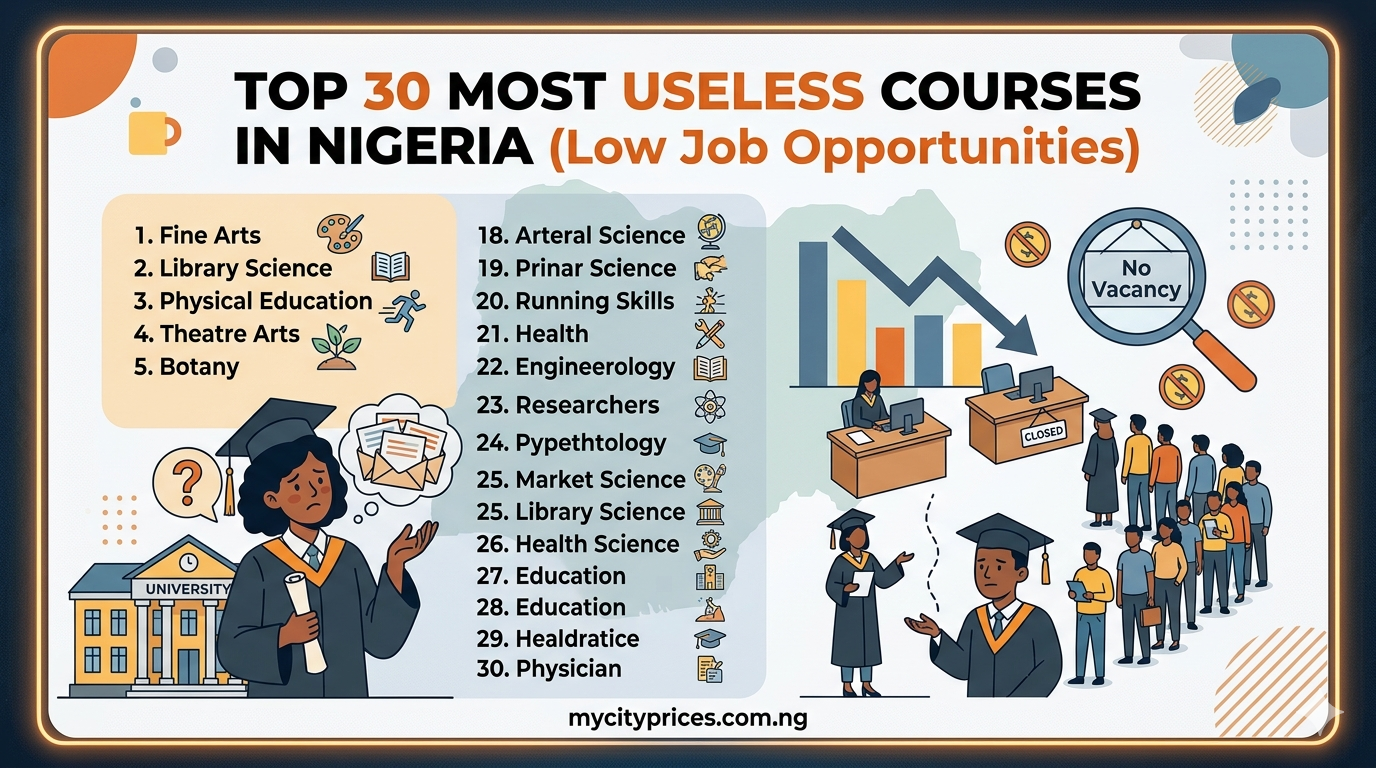
Top 30 Most Useless Courses in Nigeria (Low Job Opportunities)
Choosing a university course is one of the most important decisions a student makes. Unfortunately, many students in Nigeria study courses that have very limited job opportunities, making it difficult to secure employment after graduation.
This does not mean these courses are completely worthless. However, in Nigeria’s current job market, some degrees have low demand, fewer career options, and limited earning potential compared to fields like medicine, engineering, and technology.
In this guide, we will look at the top 30 courses with low job opportunities in Nigeria, why they are considered less profitable, and what students should consider before studying them.
Why Some Courses Have Low Job Opportunities in Nigeria
Several factors contribute to why some courses struggle in the Nigerian job market.
1. Limited Industry Demand
Some courses do not have strong industries that employ graduates.
2. Oversupply of Graduates
Many universities offer the same programs, leading to too many graduates competing for few jobs.
3. Lack of Practical Skills
Some programs are more theoretical and may not provide skills needed in today’s workforce.
4. Poor Career Awareness
Many students choose courses without researching the career opportunities available.
VIEW ALSO : Top 30 Courses With the Highest Salary in Nigeria
Top 30 Most Useless Courses in Nigeria
Below are courses that generally have low job opportunities in Nigeria.
1. Philosophy
Philosophy focuses on ethics, reasoning, and human thought.
Job opportunities:
- Lecturer
- Writer
- Researcher
However, outside academia, job options are limited.
2. History
History graduates study past events and civilizations.
Possible careers:
- Teaching
- Research
- Museum work
But these opportunities are very limited in Nigeria.
3. Archaeology
Archaeology deals with studying ancient cultures and artifacts.
Nigeria has very few archaeological institutions, making employment difficult.
4. Religious Studies
Religious studies focus on theology and spiritual traditions.
Most graduates work as:
- Teachers
- Clergy members
However, job opportunities are limited outside religious institutions.
5. Anthropology
Anthropology studies human societies and cultures.
Career options exist mainly in research and academia, which have limited openings.
6. Library and Information Science
Library science prepares students to manage libraries and archives.
Unfortunately, many Nigerian libraries are underfunded, reducing job opportunities.
7. Home Economics
Home economics focuses on food science, family management, and nutrition.
Most graduates work as teachers.
8. Theatre Arts
Theatre arts graduates study acting, directing, and stage production.
Nigeria’s entertainment industry has opportunities, but success often depends on talent rather than the degree itself.
9. Fine Arts
Fine arts involve painting, sculpture, and visual design.
While creative, the Nigerian job market for fine arts graduates is limited.
10. Linguistics
Linguistics studies language structure and communication.
Most linguistics graduates become:
- Teachers
- Translators
However, job demand is low.
11. French
French graduates can work as translators or teachers, but the demand is not very high in Nigeria.
12. Music
Music graduates can work in the entertainment industry, but success usually depends more on talent and popularity than academic qualifications.
13. Education (Certain Specializations)
Some education degrees have limited opportunities due to low demand for certain teaching subjects.
14. Sociology
Sociology studies human behavior and society.
Job options are mostly limited to:
- Research
- NGOs
- Teaching
15. Political Science
Political science graduates often aim for careers in politics or public administration.
However, job opportunities are limited without strong connections or experience.
16. Geography
Geography graduates study earth systems and landscapes.
However, there are relatively few specialized job openings.
17. Criminology
Criminology studies crime and criminal behavior.
In Nigeria, there are limited career paths for criminology graduates.
18. Peace and Conflict Studies
This course focuses on conflict resolution and diplomacy.
Most opportunities exist in NGOs and international organizations, which are limited.
19. Cultural Studies
Cultural studies focus on societal values and traditions.
Career options are usually academic or research-based.
20. Tourism Studies
Tourism can be profitable in some countries, but Nigeria’s tourism sector is still developing.
21. Agricultural Education
Agriculture itself has opportunities, but agricultural education often leads mainly to teaching careers.
22. Adult Education
Adult education graduates usually become educators in adult learning programs.
These programs are not widely available in Nigeria.
23. Local Government Studies
Local government administration is highly competitive and offers limited job openings.
24. Social Work
Social workers support vulnerable populations.
Unfortunately, Nigeria has limited funding and employment opportunities in this field.
25. International Relations
International relations graduates aim to work in diplomacy or global organizations.
However, these positions are very competitive and scarce.
26. Creative Arts
Creative arts combine various artistic disciplines.
While creative careers exist, the formal job market is limited.
27. Communication Arts
Communication arts overlap with mass communication but may have fewer direct job opportunities.
28. Demography and Social Statistics
Demography focuses on population studies.
Most job opportunities are limited to research institutions.
29. Religious Education
Religious education graduates often work as teachers or religious instructors.
Job options outside schools are limited.
30. Guidance and Counseling
Guidance counselors work mainly in schools, which limits employment opportunities.
Courses With Better Job Opportunities
Students seeking better employment prospects may consider fields such as:
- Medicine and Surgery
- Computer Science
- Petroleum Engineering
- Data Science
- Cybersecurity
- Nursing
- Accounting
- Software Engineering
These courses have higher demand in Nigeria and globally.
Should You Avoid These Courses?
Even though these courses may have limited job opportunities, they are not completely useless.
Success depends on:
- Skills development
- Entrepreneurship
- Networking
- Additional certifications
For example, a theatre arts graduate could become a successful filmmaker or content creator.
Conclusion
While some courses have limited job opportunities in Nigeria, they still play important roles in education, culture, and society.
Students should carefully research:
- Career prospects
- Industry demand
- Salary potential
before choosing a course of study.
Combining your degree with practical skills, digital knowledge, and entrepreneurship can significantly improve your career prospects.
Frequently Asked Questions (FAQs)
1. Which course has the lowest job opportunities in Nigeria?
Courses like philosophy, archaeology, and religious studies often have limited job opportunities.
2. Are arts courses useless in Nigeria?
No. Arts courses can still lead to successful careers, but students may need additional skills or entrepreneurial efforts.
3. Which courses have the highest job demand in Nigeria?
Medicine, engineering, technology, and finance-related courses generally have the highest demand.
4. Can someone succeed with a low-demand course?
Yes. Success depends on skills, creativity, and opportunities, not just the degree.
5. What should students consider before choosing a course?
Students should research job demand, salary potential, and career growth opportunities.

Leave a Reply